


Welcome to The Perihelion Moment, a monthly briefing on FCC and spectrum developments in TMT, satellite, and frontier space brought to you by Perihelion Strategies. Each issue covers what the Commission (or other relevant authorities) is doing, why it matters, and what it means for the people building and investing in this space. This is meant to start a dialogue, so feel free to email me about topics you’d like to see covered (ross@perihelionstrategies.com).
This month: the FCC’s new Spectrum Abundance Further Notice, expanded opportunities in the FCC’s Weird Space Stuff proceeding, updates on a few key proceedings, and what to watch in October.

Spectrum Abundance II: More Abundance
Shortly after this issue is published, on September 30th, the FCC will vote on a second push in its Spectrum Abundance proceeding featuring one order and two further notices of proposed rulemaking (“FNPRMs”) that would unlock extensive spectrum for satellite use.
Though it’s already fall, we’re still far from Thanksgiving, which might explain the abundance of parties fighting and pleading over the final text of the item. Below are some fun details to mull over with cider.
First Order of Business
The draft order opens the 12.7 and 42 GHz bands for satellite use, amplifying broadband capacity for users at home, on ships, and on planes, while setting forth a plan to eventually reduce the protections enjoyed by certain legacy broadcast and cable TV stakeholders. Notably, SpaceX, the Commercial Space Federation (CSF), and the Open Technology Institute sought to get NGSO operators access to the 52 GHz band, so worth watching to see if that changes in the final item.

FNPRM 1: Satellite Spectrum for All Seasons
Among other things, the first FNPRM looks to free up more spectrum for satellites in the Ku-, Ka-, and D-bands.
Each of these bands has their own advantages and disadvantages. Ku is good for pushing signals through when it’s raining but a bit limited in how much data it can carry. Ka can carry more data than Ku but doesn’t fare quite as well in bad weather.
D is seldom used because while it can carry insane amounts of data, it’s very bad at dealing with Mother Nature.
The item looks to open a massive amount (138.25 gigahertz) in and above the D-band spectrum. The main driver of this is probably SpaceX, which wants to use D-band spectrum as part of a broader plan to expand capacity for AI-powered devices in a 100,000-satellite constellation. We’ve heard bold promises about millimeter wave (“mmW”) spectrum before.1 It will be interesting to see what comes of this.
Weird Space Stuff Part Two
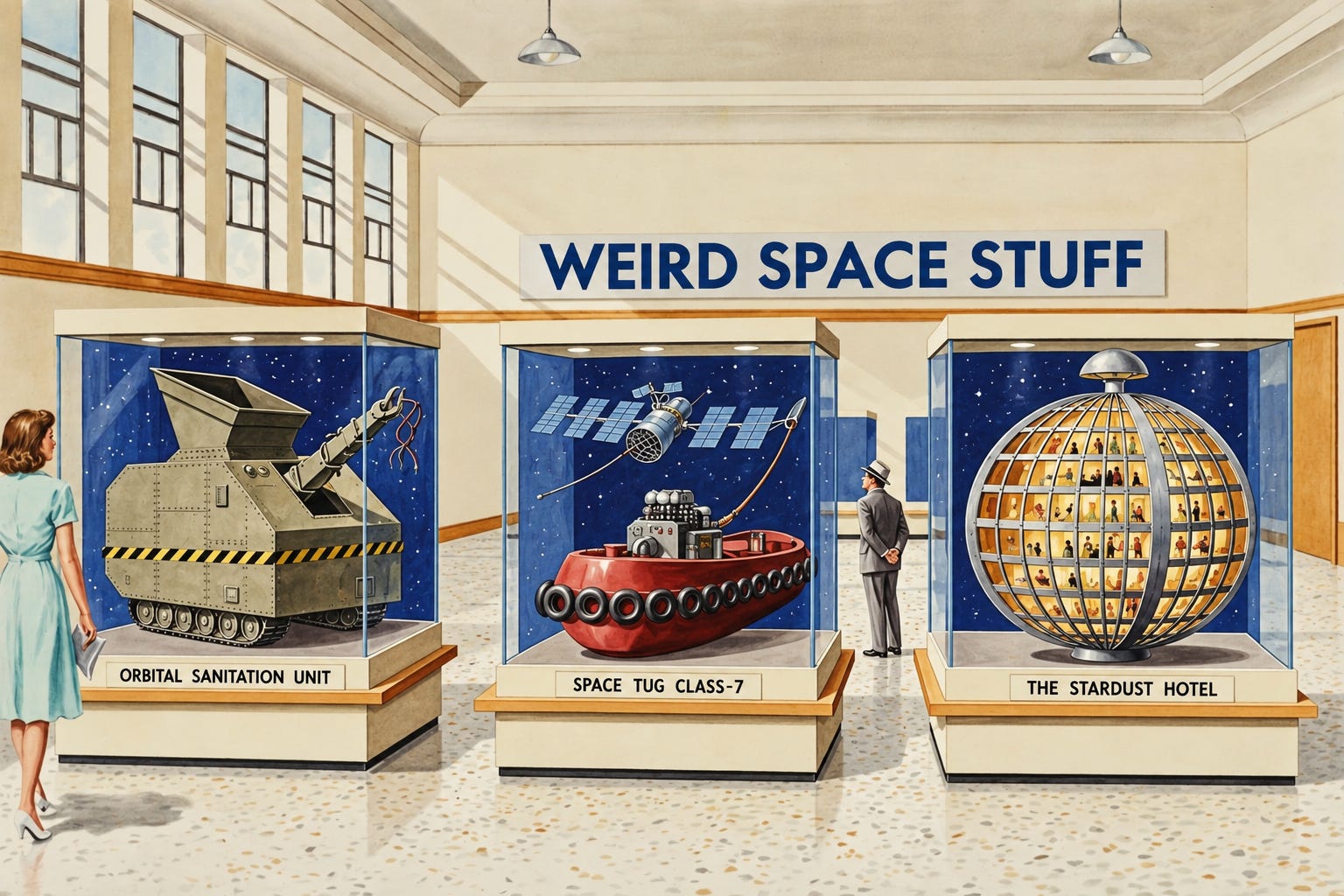
Now the fun part. People are now doing all kinds of crazy things in space - developing pharmaceuticals, building gas stations, creating multi-tenant payload warehouses, designing private space stations, etc.
Back in March, the FCC launched the Weird Space Stuff (WSS) proceeding (their title, not mine) to accommodate these operations by giving them greater flexibility to operate in existing categories and also potentially creating one or more dedicated secondary spectrum allocations.
A key proposal was to allow SiriusXM to lease its 2320-2345 MHz band spectrum to some of these parties, and potentially extend leasing to adjacent bands.2
Presently, the Further Notice considers allowing WSS to operate in the 2360-2395 MHz, 13.25-13.4 GHz, and 100-300 GHz bands. 2360-2395 MHz could potentially support emergent space operations but needs coordination with flight testing stakeholders. 13.25-13.4 GHz could enable heavier-duty comms for things like private space stations and docking systems. And, despite its limitations, with bespoke equipment 100-300 GHz spectrum could be a game-changer.
This is a brave new world, and parties building and deploying WSS applications have a real chance to shape the rules to their benefit.

Updates
NextNav. Busy month full of tailwinds and headwinds. A major alliance urged the FCC to push forward the alternative PNT NPRM; NextNav successfully field tested its 5G PNT tech exhibiting robust location accuracy results; and the company hired a new VP of government affairs. However, a new coalition formed opposing NextNav’s proposal; another alliance asked the FCC to reinstate the 900 MHz band in the unlicensed D2D proceeding; and a separate party claimed NextNav’s field test used artificially low power levels and hence understated the interference risks.
Equipment Authorization. On September 22, Frank Pallone (D-NJ) and Brett Guthrie (R-KY) introduced a bill that would empower Congress and the Department of Commerce to add technologies or equipment that pose a national security threat to the Covered List. It also sets up greater congressional oversight of related FCC activities. We’ll see if it gains any steam after midterms.
CSF Petition for Rulemaking. We promised you a fight and you’re getting one. Many parties weighed in, with rocket companies seeking various reforms and greater transparency in coordination, defense and aviation interests seeking to protect their operations, CSF and SpaceX doubling down, and AFTRCC both inviting dialogue on improving the existing framework and understandably defending itself. Though there’s consensus on the need for change, in many cases the agreement stops there.

What to Watch in October
Next month, a few dates that go bump in the night:
October 13. New rules take effect that close a loophole in the equipment authorization process - parties can no longer incorporate into their devices any logic-bearing hardware components made by Covered List entities if the device itself is of a type that a Covered List entity would be barred from getting authorized. These rules are moving fast and might haunt inattentive operators.
October 19. Responses are due for a Space Systems Command request for ideas on spacecraft that can launch on short notice and quickly close on a target for rendezvous, proximity operations, and docking missions for FY 2029 and beyond. A key skeletal outline of desired Space Force capabilities.
October 21. DARPA will close its request for proposals for spacecraft electric propulsion systems capable of operating on air, water, or mixtures incorporating elements like nitrogen or hydrogen. So still a few weeks to brew up something for those of you with a cauldron at home.
Beetlejuice. Always good to watch this month, but don’t say it three times.

About
Ross Slutsky is the founder of Perihelion Strategies, Limited (PSL), an independent FCC regulatory strategy and intelligence firm that helps operators and investors understand what the FCC is doing, engage it effectively, and position themselves to win at the moments that determine outcomes. Before founding PSL, Ross spent time at the Commission, in big law, and in-house at a leading global satellite operator. In his downtime he enjoys film, family activities, and flying trapeze.
The Perihelion Moment is published monthly by Perihelion Strategies, Ltd. Nothing here is legal, financial, or investment advice.
Your author is old enough to remember industry promising that 5G millimeter wave tech would result in the world below. (It did not.)

Admittedly, though, satellites with clear lines of sight are a different play than physically obstructed terrestrial wireless systems. While it’s had some value in fixed wireless and other limited deployments, if someone truly cracks mmW, they will make a fortune.
The item also evaluated the prospects of making spectrum available in the 2305-2315, 2315-2320, 2345-2350, and 2350-2360 MHz bands.