
Welcome to The Perihelion Moment, a monthly briefing on FCC and spectrum developments in TMT, satellite, and frontier space brought to you by Perihelion Strategies. Each issue covers what the Commission (or other relevant authorities) is doing, why it matters, and what it means for the people building and investing in this space. This is meant to start a dialogue, so feel free to email me about topics you’d like to see covered (ross@perihelionstrategies.com).
This month: all the messy drama in the Direct-to-Device (D2D) world and the FCC’s related proposal, views on the prospects and scope of a potential ban on foreign-produced optical transceivers, and what to watch in November.
Setting Up Satellite Situationships
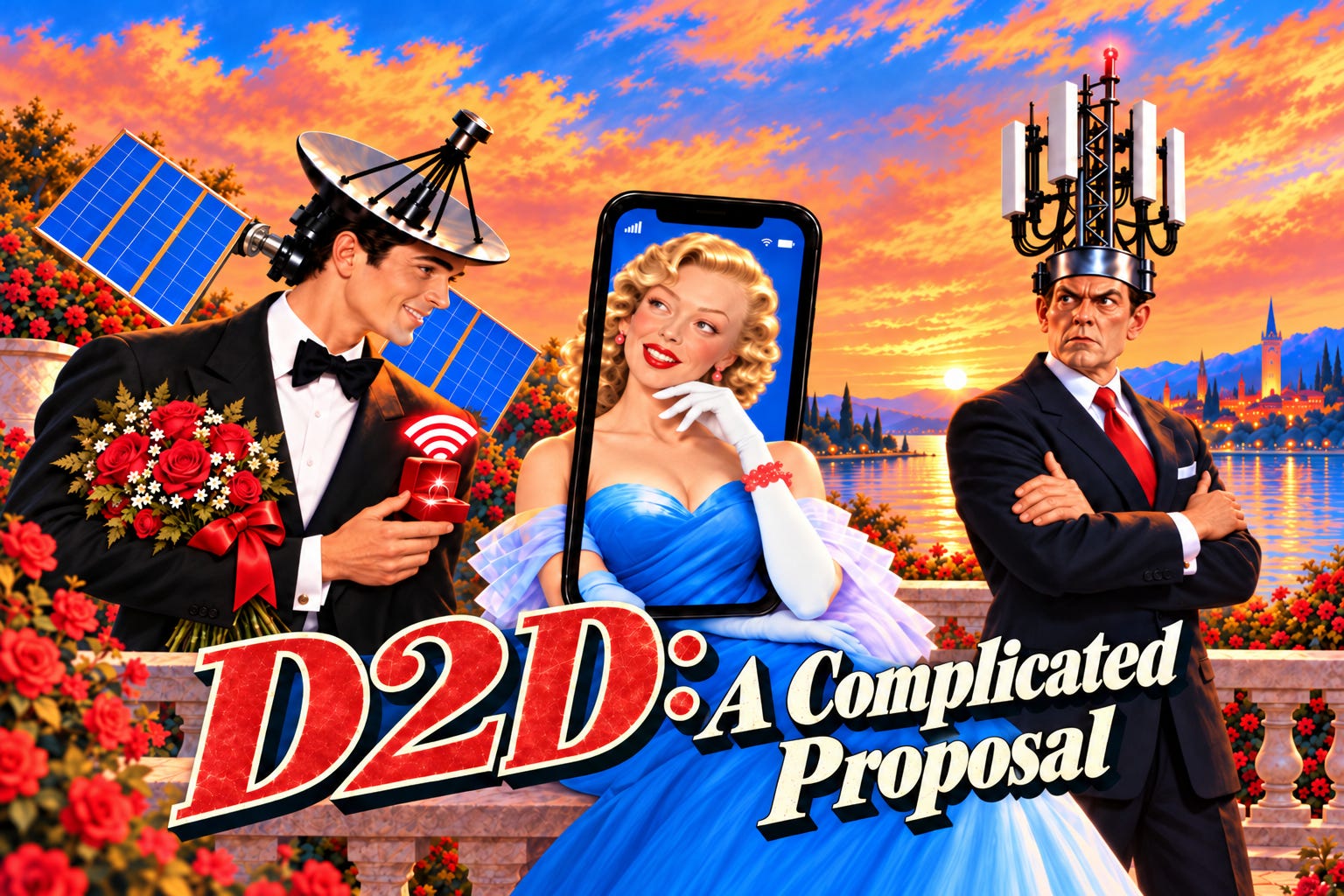
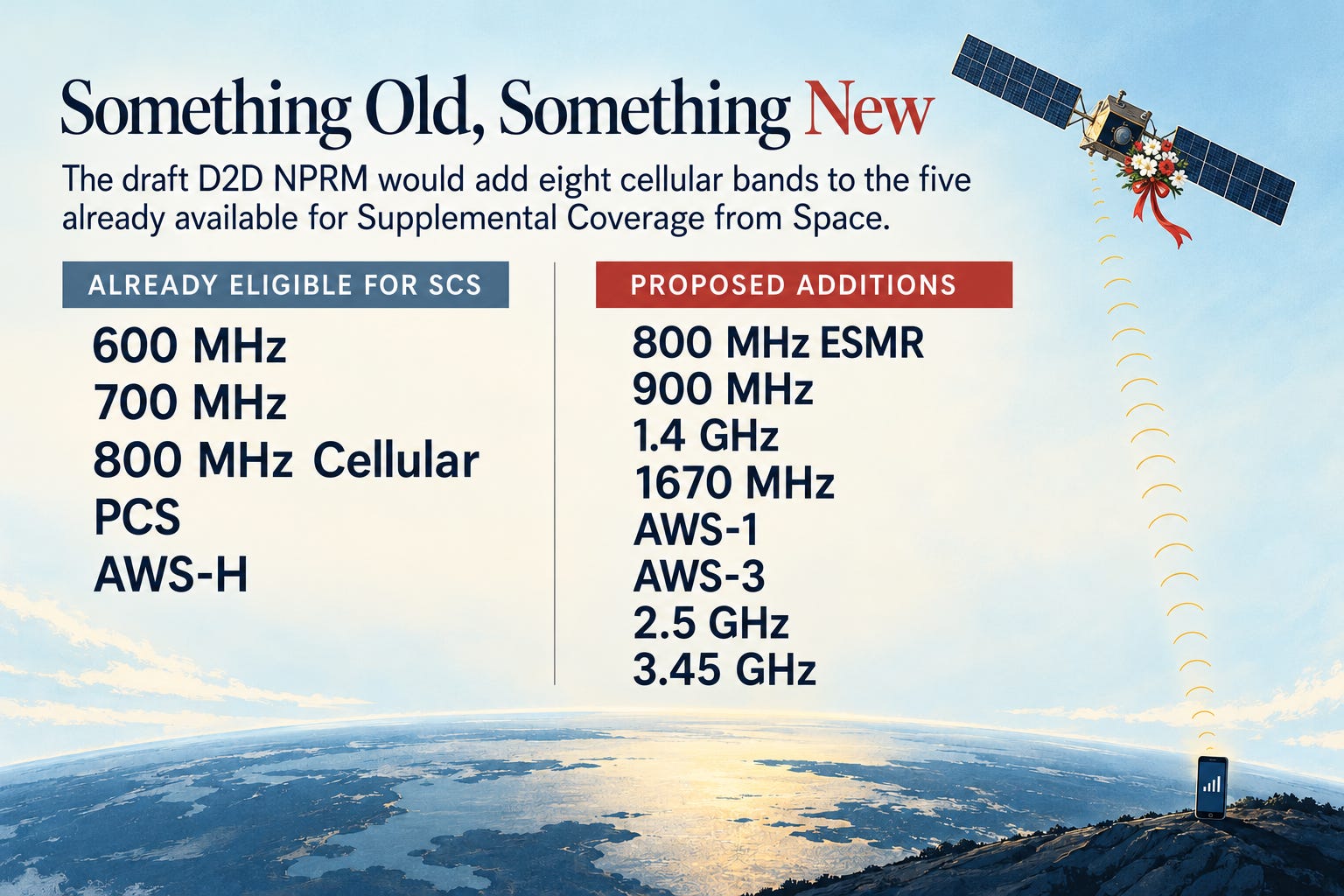
While TPM often covers the FCC’s expansion into national security, with this month’s new D2D proposal, the agency finds itself in Judge Judy’s seat brokering a soapy love triangle between cell phones, cell towers, and satellites. Freeing up the bands listed above for D2D is only part of the equation.
The other part is figuring out who gets to pair up. Cell phones have longstanding relationships with Verizon, AT&T, and T-Mobile, but some attractive alternatives have entered the picture (e.g., SpaceX, AST SpaceMobile, and Lynk Global).
Also, consider the fraying relationship between T-Mobile and SpaceX. In 2025, they launched T-Satellite, using Starlink satellites to eliminate dead zones in rural and remote areas. But now T-Mo has scrubbed Starlink’s name from T-Satellite’s webpage and is forming a new satellite venture with Verizon and AT&T.1
Meanwhile, their custody battle is heating up. Earlier this month, SpaceX struck back by buying T-Mobile’s old 800 MHz spectrum from Grain Management (pending FCC approval), and is reportedly putting more pressure on the big three by talking to Crown Castle (and possibly other companies) about plans to access 80,000 terrestrial cell sites.

Enter the FCC.
Under the existing framework, a satellite company that wanted to do direct-to-cellular needed a lease from someone holding relevant spectrum rights across massive regions like the full continental United States, which typically meant one of the big three.
This month’s draft NPRM would loosen this framework. Instead of leases, satellite and terrestrial operators could strike more flexible arrangements and certify them to the Commission. Instead of having to span the continent, D2D providers could get carte blanche to draw their own boundaries.
Stated differently, the Commission is inviting open relationships.2
While much attention will go toward what this means for mega-constellations, tower companies, and the big three, your author is more interested in second-order effects: whether a more flexible framework gives smaller carriers and regional spectrum holders something new to sell.
We’ll have to see whether the new challengers can spice things up.

Bad Optics?
Don’t worry. Back to FCC national security adventures. The Commission may soon regulate an obscure but pivotal component of AI data centers known as optical transceivers.
In essence, optical transceivers translate data between servers and fiber-optic cables. There are three main tiers: 800G (widely deployed), 1.6T (ramping now), and 3.2T (late-2020s next generation).
While some security experts are skeptical, proponents of the ban believe optical transceivers could be exploited to steal data, install malware, or disrupt critical infrastructure.
This sets up a game of limbo in multiple respects.
First, the timing is in limbo. Rumors of a ban have circulated for months, and there’s a legislative proposal behind it, but optical transceivers still haven’t hit the Covered List. Depending on who you ask, it could happen later this year, early next, or not at all.3
Second, assuming a ban occurs, the question becomes how low do you go?
According to Morgan Stanley analysis from earlier this month, the administration may draw the line by putting 3.2T on the Covered List. If a ban has to happen, 3.2T is the line markets would find easiest to swallow: it avoids ripping and replacing 800Gs, leaves the 1.6T ramp largely intact, and gives U.S. industry several years to scale 3.2T output.
Although a ban would likely cover “foreign-produced” optical transceivers, the real target is Chinese vendors, which account for 66% of the global supply.
While this might seem like a boon for U.S. optical transceiver companies, the ultimate outcome may be up to Beijing instead of Washington. China produces 70% of the world’s indium—an essential input for the lasers used in high-speed optical transceivers—and could easily retaliate by tightening its export controls. The million-dollar question is how quickly and economically U.S. producers could adjust.
The U.S. and China are locked in a race for AI supremacy. The fastest way to grow U.S. capacity is by relying on global supply chains that include Chinese components. But that same interdependence could undermine the security of the AI systems U.S. companies are rushing to build. It’s a problem far easier to name than to solve.
If you’re a hyperscaler, data-center developer, optical supplier, or investor in the AI infrastructure stack, now might be a good time to join me in doing some lower back stretches.4
What to Watch in November
Nothing like Federal Register stuffing. Gobble gobble.
November 5. Double trouble. Reply comments are due in the FCC’s equipment authorization proceeding (ET Docket No. 21-232) examining where the Covered List regime goes next, considering software and firmware rules and more granular bills of materials. Also due: initial Upper C-band transition plans (GN Docket No. 25-59) covering how eligible operators would repack services, migrate customers, modify earth stations, and potentially launch new satellites to clear spectrum ahead of the auction.
November 16. Comments are due on the FCC’s reevaluation of how 911 emergency-service obligations should apply to evolving network architectures (PS Docket No. 26-197). D2D and LEO constellations make the question of who must provide 911 access more interesting than it sounds at first blush.
November 18-19. In another surprising love triangle, Trump, Xi, and possibly Putin may meet at the APEC summit in Shenzhen. Watch for new White House signals on Chinese technology restrictions. If optical transceivers get swept in, query how much transition time industry will get.
November 25. Comments are due on the FCC’s Space Modernization FNPRM (SB Docket No. 25-306). Buried inside: advance notice for rendezvous and proximity operations, trackability rules that reach cislunar space, and 20-year license renewals for satellites kept alive by servicing spacecraft. Have at it, Weird Space Stuff folks!
See you next time.

About
Ross Slutsky is the founder of Perihelion Strategies, Limited (PSL), an independent FCC regulatory strategy and intelligence firm that helps operators and investors understand what the FCC is doing, engage it effectively, and position themselves to win at the moments that determine outcomes. Before founding PSL, Ross spent time at the Commission, in big law, and in-house at a leading global satellite operator. In his downtime he enjoys film, family activities, and flying trapeze.
The Perihelion Moment is published monthly by Perihelion Strategies, Ltd. Nothing here is legal, financial, or investment advice.
But the Internet can still keep those random commercials with Billy Bob Thornton in the middle of nowhere.
However, open relationships come with ground rules. Satellite operators would have to hit performance benchmarks or lose their licenses. And for the traditional satellite-phone bands, the Commission seems more interested in renewing vows of exclusivity.
Morgan Stanley said the ban could happen as early as October, but it hasn’t happened yet. Reuters said to expect it by the end of the year. Only time will tell. ⏱️.
Fun fact. In 1991, Dennis Walston set the limbo world record by passing under a 6-inch bar.